World Types
World Types Explained
Last updated 6 months ago
When you create a new world in aiga_, the first thing you choose is the world type. This determines the core gameplay loop: how your story progresses, whether your character can die, and what kind of ending (if any) the adventure has.
aiga_ offers four world types.
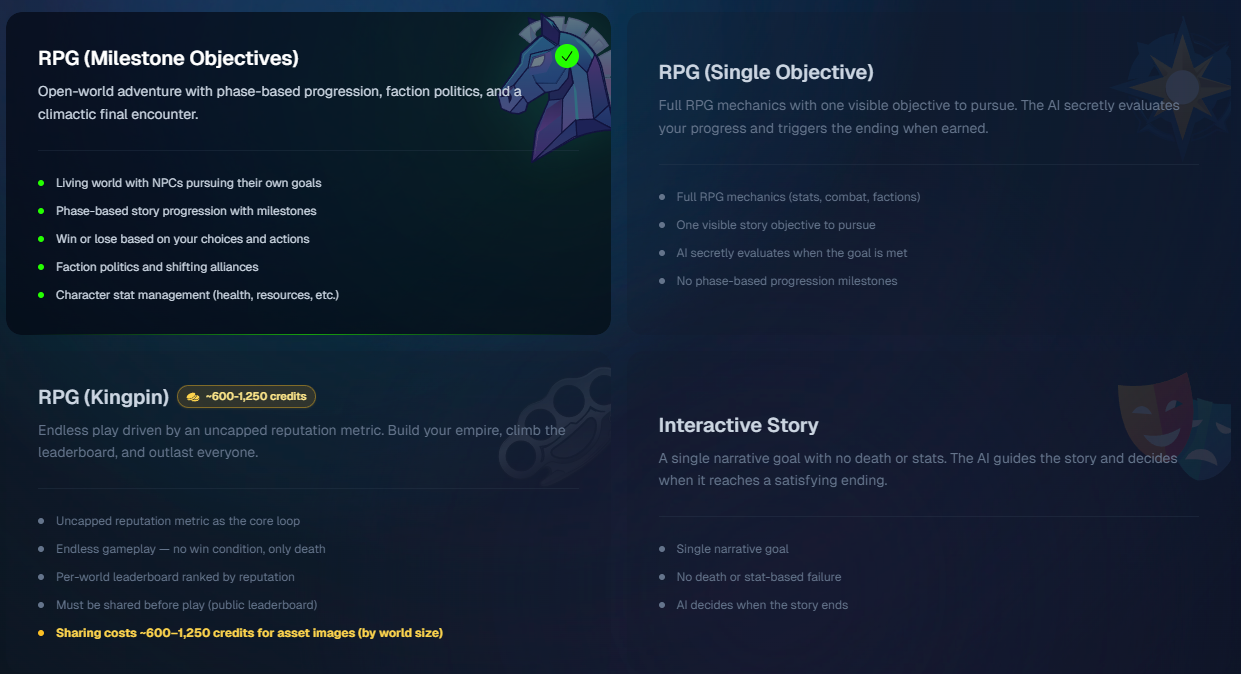
RPG (Milestone Objectives)
An open-world adventure with phase-based progression, faction politics, and a climactic final encounter.
This is the classic RPG experience. The AI generates a living world with locations to explore, NPCs with their own goals, competing factions, and shifting alliances. Your character has stats (health, resources, and more), an inventory, and traits that affect how the story unfolds.
The story progresses through phases with milestones. As you complete objectives, you advance through phases until you reach a dramatic final encounter. Your choices and actions determine whether you win or lose.
Key features:
Living world with NPCs pursuing their own goals
Phase-based story progression with milestones
Win or lose based on your choices and actions
Faction politics and shifting alliances
Character stat management (health, resources, etc.)
Best for: Players who want a structured adventure with clear progression, meaningful stakes, and a definitive ending.
RPG (Single Objective)
Full RPG mechanics with one visible objective to pursue. The AI secretly evaluates your progress and triggers the ending when it's earned.
This mode gives you the same deep RPG mechanics as Milestone Objectives (stats, combat, factions, inventory), but replaces the phased progression with a single overarching goal. You can see what your objective is, but you will not know exactly when the AI decides you have fulfilled it. The ending arrives when it feels narratively earned, not after a fixed number of milestones.
Key features:
Full RPG mechanics (stats, combat, factions)
One visible story objective to pursue
AI secretly evaluates when the goal is met
No phase-based progression milestones
Best for: Players who want RPG depth but prefer a more organic, less structured path to the finish line.
RPG (Kingpin)
Endless play driven by an uncapped reputation metric. Build your empire, climb the leaderboard, and outlast everyone.
Kingpin worlds are competitive and endless. Instead of progressing toward an ending, you build up a reputation score that has no cap. The only way your run ends is if your character dies. Every player who plays a Kingpin world gets their own private game session, but their reputation is tracked on a public leaderboard for that world.
Because Kingpin worlds are competitive, there are a few special rules:
The world must be shared before anyone can play it. This generates the world's asset images, which costs roughly 600 to 1,250 credits depending on world size.
Each player's game session is private (no one can see your moves), but the leaderboard is public.
The risque narrative tone is not available for Kingpin worlds.
Rewinding (undoing a turn) is not allowed, since scores are competitive.
Reputation only changes from completed narrative actions within the story, not from simply asking the AI for it.
Key features:
Uncapped reputation metric as the core loop
Endless gameplay with no win condition, only death
Per-world leaderboard ranked by reputation
Must be shared before play (public leaderboard)
Sharing costs approximately 600 to 1,250 credits for asset images (varies by world size)
Best for: Players who enjoy competition, high-score chasing, and proving they can outlast everyone else. Also great for world creators who want to build a community challenge.
Interactive Story
A single narrative goal with no death or stats. The AI guides the story and decides when it reaches a satisfying ending.
This is the most relaxed world type. There are no player stats, no health bar, and no way to die. You have a single narrative goal, and the AI acts as a storyteller guiding you toward a satisfying conclusion. The story cannot end until you have explored the world's characters and locations. Once you have, the AI will bring the narrative to a close when the arc feels complete.
Even though there are no stats or death, Interactive Story worlds still feature a full map with locations, NPCs, factions, and an inventory. The difference is that these elements serve the narrative rather than creating mechanical risk.
Key features:
Single narrative goal
No death or stat-based failure
AI decides when the story reaches its natural ending
Best for: Players who want a choice-driven fiction experience without the pressure of survival mechanics. Great for storytelling, role-playing, and exploring a world at your own pace.
Additional Settings (All World Types)
Regardless of which world type you choose, you also configure these settings during world creation:
World Size -- Small, Medium, Large, or Huge. Larger worlds have more locations, characters, factions, and story milestones.
Reading Age -- Kids (simple language, positive themes), Teen (moderate complexity, coming-of-age), or Adult (complex narratives, mature themes).
Narrative Tone -- Sets the mood of your story. Options include lighthearted, dark, epic, mysterious, romance, comedic, gritty, cinematic, surreal, and more. The risque tone is only available for adult reading age and is not available for Kingpin worlds.
Art Style -- Choose the visual style for generated images, from Cinematic Storybook to Anime, Pixel Art, and beyond.
Story Outline -- Describe your world, its setting, and the player's goal or journey. Think of it as a short elevator pitch.
Hero -- Name and describe the character you will play as.
Still need help? Ask the team