Create a World — Step-by-Step
Last updated 7 months ago
Step 1: Choose Your World Type
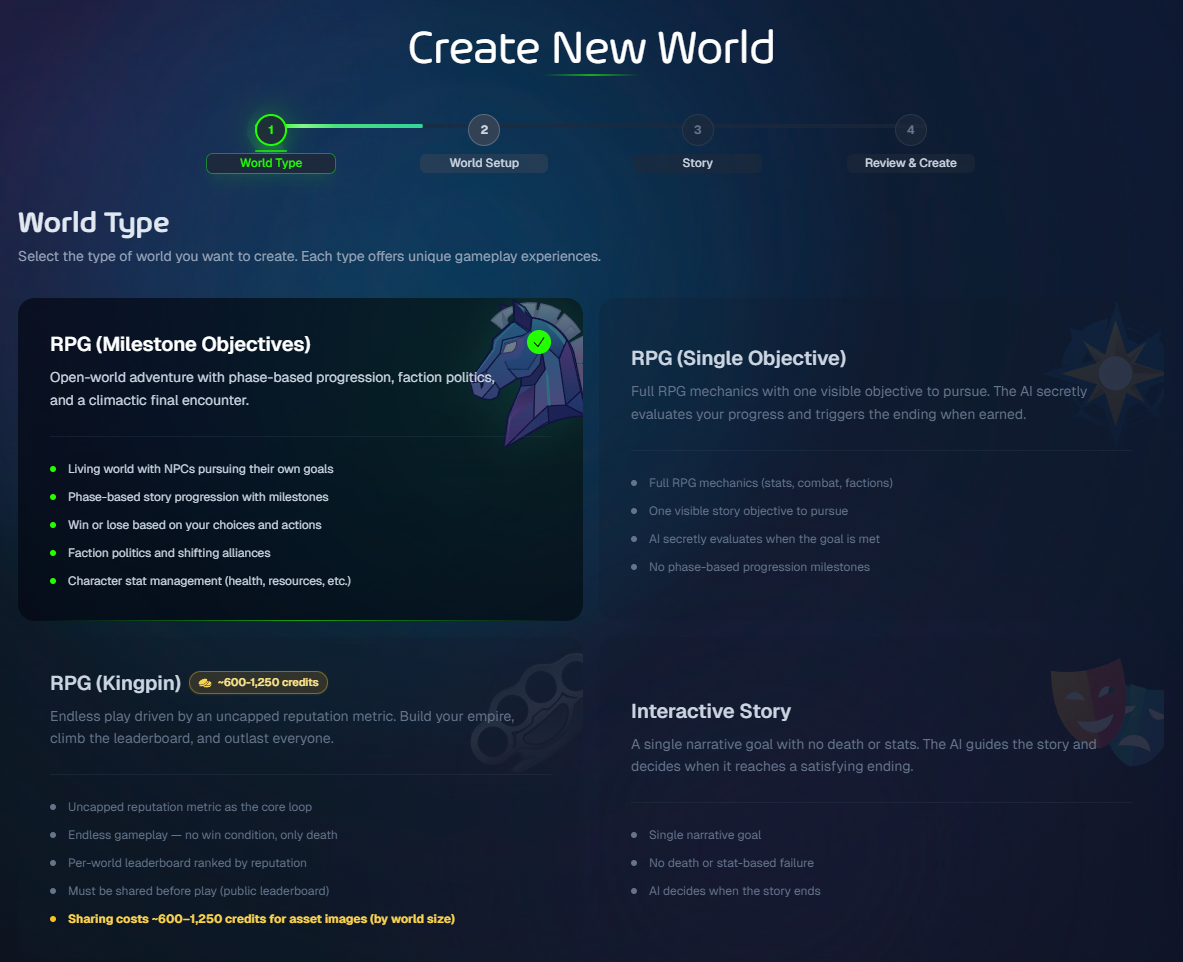
The first decision is what kind of experience you want players to have. On aiga_, you pick from four world types, each with different mechanics and pacing:
AI RPG (Open World)
A full open-world adventure with RPG mechanics. Players have stats (health, reputation, skill-based metrics), an inventory, and traits that evolve over time. The world has multiple phases that build toward a final encounter. Factions pursue their own goals in the background, and NPCs remember how the player treated them. This is the most feature-rich option and works well for fantasy epics, sci-fi survival, post-apocalyptic exploration, and anything where progression matters.
RPG Single Objective
Similar RPG mechanics to the open world, but focused around one broad goal. The AI decides when the player has achieved it. This works well for heist stories, rescue missions, mystery investigations, or any scenario with a clear finish line.
RPG Kingpin
An endless mode where players build reputation without a defined ending. There is a global leaderboard so players can compete for the highest score. This works for empire builders, crime sagas, business simulations, or any world where the fun is in climbing the ranks.
Interactive Story
A purely narrative experience with no stats, no inventory, and no death mechanics. The focus is entirely on story, dialogue, and atmosphere. This is the right pick for romance, drama, slice of life, literary fiction, or any concept where game mechanics would get in the way.
Step 2: Configure Your World
Next, you set three properties that shape how much content the AI generates:
Language
Choose from 16 supported languages. The AI generates all world content, NPC dialogue, and narration in your chosen language. This is not machine translation layered on top of English. The entire world, including character names, place names, and cultural references, is generated natively in that language.
World Size
This controls how much the AI creates:
Bigger is not always better. A small, tightly designed world can be more compelling than a huge one with spread-out content. Start small if it is your first world.
Reading Age
Choose between a kid-friendly vocabulary or an adult one. This affects the AI's language, themes, and intensity level throughout the entire experience.
Step 3: Define Your Story
This is where you bring your idea to life. You provide three pieces of information that the AI uses as the foundation for everything it generates:
Theme and Story Outline
A free-text description of your world concept. This can be as short as a sentence or as detailed as a few paragraphs. The AI reads this and builds the entire world around it: locations, NPCs, factions, conflict, and plot structure. The more specific you are, the more tailored the result.
For example: "A cyberpunk megacity in 2087 where five megacorps control different districts. The player is a freelance fixer caught between corporate espionage, underground resistance, and a rogue AI that is waking up in the city's infrastructure."
Narrative Tone
This sets the mood for the entire experience. You can choose from tones like lighthearted, dark, epic, mysterious, comedic, wholesome, gritty, cinematic, surreal, and more. The tone affects how the AI writes narration, how NPCs behave, and what kinds of events unfold.
Your Hero
Give your main character a name and a description. This is who the player becomes when they enter the world. The AI uses the hero description to shape how NPCs react, what dialogue options feel natural, and how the character fits into the world's power dynamics.
What the AI Creates for You
Once you submit your concept, the AI generates a complete world in about a minute. Here is everything you get:
A Full Map with Points of Interest
The AI creates a spatial map with named locations spread across it. Each location has a description, visual prompts for art generation, and a role in the story. Players travel between these points as the narrative progresses. A small world has 5 locations; a huge world has 20.
Characters with Depth
Every NPC gets a name, role, personality, physical description, attitude toward the player (ally, neutral, or hostile), a starting location, traits, their own inventory, and personal stats. NPCs are not just dialogue dispensers. They have motivations, and their relationship with the player evolves based on how interactions go.
Between story events, players can @mention any character to start a free-form conversation. Ask the suspicious merchant what they really know. Convince the rival faction leader to switch sides. The AI stays in character based on each NPC's personality and attitude.
Factions with Goals
Factions are groups that exist in your world with their own descriptions, goals, and attitudes. They act autonomously in the background. A faction might seize territory, betray an ally, or come to the player's aid based on how the story unfolds. This makes the world feel alive even when the player is not directly interacting with a faction.
Player Stats and Inventory
For RPG world types, the AI generates 4 to 7 stats tailored to your theme. A horror survival world might have Sanity, Stamina, and Suspicion. A political drama might have Influence, Wealth, and Public Trust. Each stat has a range and can be marked as spendable or lethal (game over if it hits zero or max).
The player also starts with 2 to 3 inventory items relevant to the setting. New items, traits, and stat changes are earned through gameplay as the story progresses.
Lore and World Context
The AI writes background lore that it references during gameplay. This includes the world's history, the relationships between factions, cultural details, and the current state of affairs when the story begins. You do not need to write any of this yourself. The AI infers it from your theme and generates internally consistent lore.
Story Progression
For RPG worlds, the AI creates a progression structure with phases that build toward a final encounter. Each phase has transition conditions: reach a certain stat threshold, gain a specific trait, discover a location, shift a faction's attitude, or hit a story milestone. This ensures the narrative has momentum without being on rails.