Party Play: How It Works
Play one story with friends, each with your own hero: the party leader, rounds or one by one, trades and the Players tab.
Last updated About 13 hours ago
In a party game, up to four players share one story. Everyone plays their own hero, the party sticks together, and the story answers all of you. Here's how it plays.
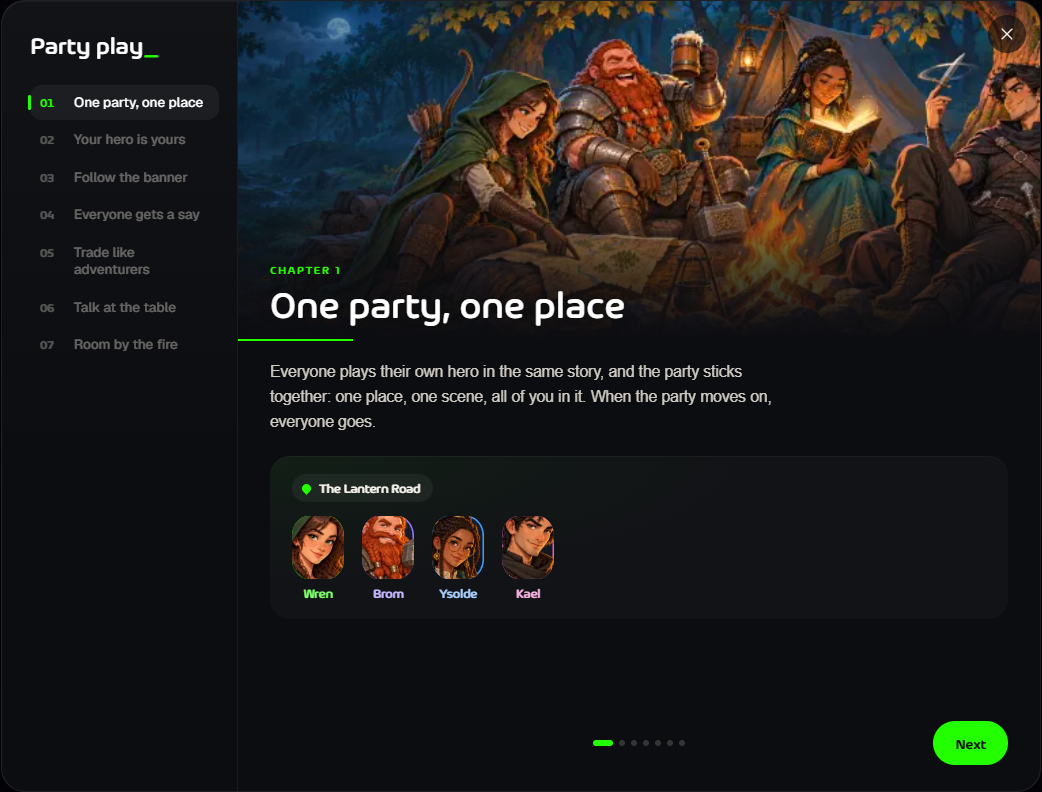
Open the guide in any game: gear at the top right → Party → How party play works.
One party, one story
Your hero is yours. Your own name, look, traits, items, coin and health, and your own suggestions after every turn. The story never speaks or decides for another player's hero.
One place, one scene. The party sticks together. When it moves on, everyone goes.
The party leader carries the banner. Only the leader's moves take the party somewhere new. If someone else wants to go, their hero says so and the leader decides. The game's owner leads first and can hand the banner to anyone, or take it back, in Party. The leader can pass it on too.
Taking turns
The owner chooses how the party takes turns: gear at the top right → Turns. The setting appears once a friend has joined.
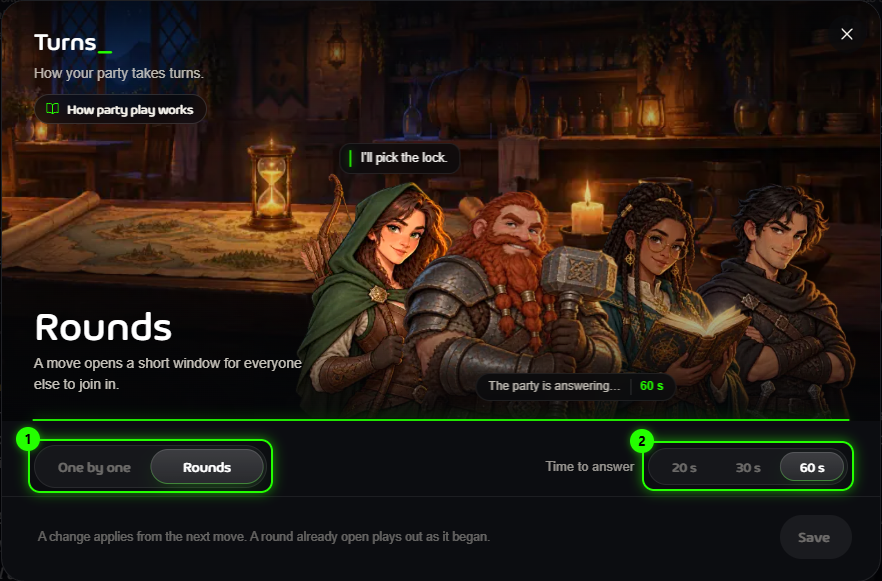
Rounds (1) are the default. A move opens a round, and everyone else has the Time to answer (2) to back it up, make a move of their own or sit it out: 20, 30 or 60 seconds, 60 by default. Then the story plays every move together, in one scene, in the order they were sent. Each move gets its own dice roll.
One by one answers each move on its own, right away. While a teammate's move is playing, your words wait in the box.
A change applies from the next move. A round that is already open plays out as it began.
During a round
Your teammates' moves show in your box as they write them, each in their own colour. A move that's sent shows In.
Use Change or Take back on your move, or Sit this one out. If the first move is taken back and nobody else is in, the round is off.
The round closes when the time runs out, when everyone has answered, or when nobody else has the game open. Whoever opened it can click Go now to play it early.
Missed a round? Nothing happens to your hero: they just don't act in that scene.
A move opens a round only when another hero is standing in the same place. Otherwise it plays as an ordinary turn.
With the game in a background tab, the tab shows Your move when the party is waiting for you.
Trading and talking
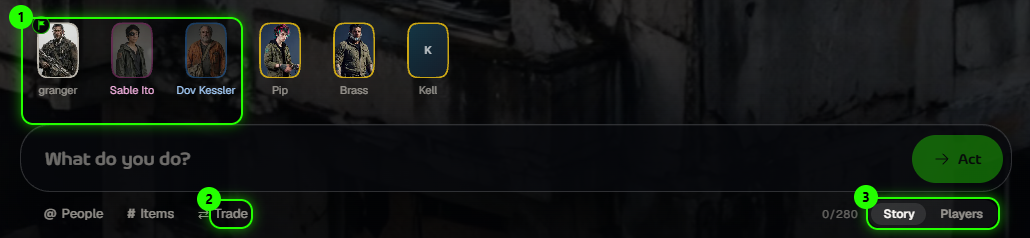
Heroes in the scene (1). Every player has a colour of their own; yours is green.
Trade (2). Hand over an item, pour in some coin, or swap. Nothing changes hands until the other player accepts, and the story tells it when they do. Both heroes need to be in the same place.
Players (3). Chat with your party beside the story: plan, joke, argue. The story never reads it, and it's free. Story takes you back to the game.
What's different in a party game
Fights are settled in a single roll. There are no Showdowns while playing with others, for now.
Only the owner can rewind, change the game's settings, paint scenes, use Listen and delete the game. A rewind also undoes the other players' turns and trades since then.
If a hero falls, they're Downed and the party can help them up. A downed hero left behind when the party moves on dies. If your hero dies, you can make a new one while a seat is free.
Friends who join later walk into the scene with a starting kit of their own: 2 to 3 traits and 1 to 3 items.
Who pays? The host. On a paid plan, party turns are included; without one they use the host's free turns, then credits. See Party Seats, Plans and Costs.
Related articles
Was this helpful?
Still need help? Ask the team